Apologies for temporary loss of service

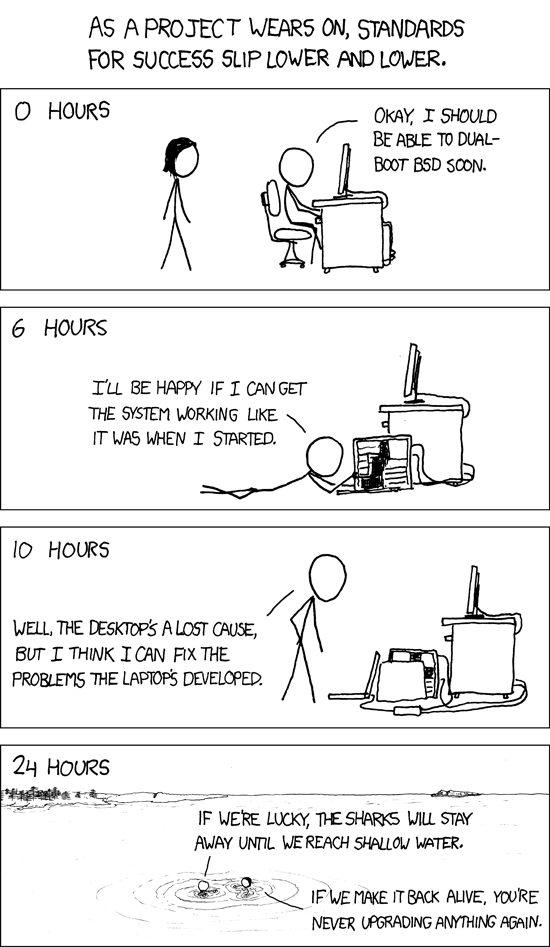
Steve has been migrating all of the accounts on grommit to the new SuperMicro box, and it took a couple of hours. Everything should be working now (and working much faster!).
Apart from installing the new box, Steve made a raft of useful changes:

  • Installed OpenSolaris Nevada, build 75
  • Replaced uw-imap with Dovecot
  • Upgraded Squirrelmail
  • Moved from PHP4 to PHP5
  • Cleaned up and regenerated all keys and certs

Many thanks, Steve.

Slippery

From my favourite pilot’s blog ((Well worth bookmarking – only one or two posts a week, but always with a nice photograph.)), Flight Level 390: See what happens when you try to manoeuvre 75 tons of A320 ((“Fi-Fi” to her friends.)) on a sheet of ice:

After we loaded 150 passengers and bags, the tug crew pushed our aircraft shaped iceberg back while the co-pilot started number one engine. Ground control cleared us to taxi to the ice pad. As I advanced number one throttle, Fi-Fi slowly slid on the icy ramp in the direction of the thrust vector. Ooops! Not good… We are forced to start number two for symmetrical thrust. Slowly, very slowly, I taxied to the Ice Man’s ramp which was full of airliners being sprayed with hot de-icing fluid. Ice Man, actually a woman, asked us to proceed to spot #9 and configure the aircraft for de-icing fluid. Then, in a last second change of plans, she asked us if we could proceed to spot #7. I turned the nose wheel left but Fi-Fi kept going straight.
“Tell her we can’t accept spot #7.”

No kidding.

Kindle – first impressions

The first thing I did last Monday morning Amazon Kindle– even before having breakfast – was to order myself a Kindle ebook reader. I had seen a prototype some months ago, and I knew I was going to want one. At the same time, I ordered a 2GB SD card; I figure that should hold me forever. While waiting for delivery, I read the various “reviews” and blog comments, most of which seemed to be written by people who had never seen a Kindle, and who kept repeating the same rhetorical questions which they could probably have answered very easily if they’d bothered to think. ((History lesson for Cory: the first Apple iPod came out in 2001, priced at $399. It took another six years for the major music businesses to abandon DRM. See also Neil Gaiman’s perspective.))
Also while I was waiting, I arranged for some downloads to be in the queue when I powered up the device for the first time. I bought one book (“The World Without Us” by Alan Weisman), and ordered previews of two others (“Takeover” by Charlie Savage, and “Arsenals of Folly” by Richard Rhodes). I also practiced transcoding a couple of files into Kindle format using the free non-wireless approach. ((You mail a suitable file as an attachment to NAME@free.kindle.com, and Amazon emails you a link from which you can download the file to your PC or Mac; then you can transfer it via USB to the Kindle.))
At 5:45pm today it finally arrived. (Yes, I was like a little kid waiting for Santa.) I opened it up ((Admiring the gorgeous packaging – this is an area where I think Apple has raised the bar for the whole industry.)), turned it on, and found myself reading the pre-loaded user guide. By the time I located the “Home” key, the content I had pre-ordered was already installed. Then I turned it off, removed the back panel, and plugged in the SD card. At this point, I encountered the only glitch so far: when I turned it back on, I couldn’t get a wireless signal. I checked the various menus to see if I could see any wireless settings ((No, of course I didn’t read the manual. Who do you think I am??)), spotted a “Restart” option, clicked it, and the Kindle came right back up with an 80% signal. Not a big deal.
Reading on the Kindle just feels right. There are six font sizes, and I picked the smallest, which works for me. ((I could perhaps have used a seventh, even smaller, setting, but that might have been pushing it.)) People have described the design as “bland”, but for me that’s actually the point. After using the Kindle for a few minutes, you don’t notice it any more, which is as it should be. Intrusive, edgy styling would be exactly wrong for this kind of device. The controls work well, and I especially like the “silver strip” cursor.
I started reading “Arsenals of Folly”, and kept reading until I reached the end of the preview chapter… And that’s when it became expensively seductive. Because there’s a link there inviting you to buy the full book, and one click, $9.99, and 30 seconds later you’ve done exactly that. My advice: choose those previews with care, because it’s far too easy to buy. (Or perhaps I should just say that it’s a very compelling user experience!) ((Speaking of prices, the Amazon Kindle store has a remarkably long tail, priced from $0.01 (really!) to $1,079.96. And of course you can also get 20,000+ free titles from Project Gutenberg.))
This is easily the best ebook solution I’ve encountered. I’ve tried reading ebooks on my PC or Mac – wrong, wrong, wrong: reading a book is a “sitting back” activity, while using a PC is a “sitting forward” thing. (That’s a fundamental dichotomy, which is why you can comfortably watch a DVD on a laptop but not a desktop.) I’ve tried various PDAs, but the screens are too small and the fonts are always ugly. I’ve never tried a tablet PC, but that seems far too heavy and bulky. The Kindle just works. The size and weight are appropriate, I find the fonts “comfortably satisfying”, if that makes any sense, and the e-paper screen is unobtrusive, the way that the page of a book is supposed to be.
Things to try tomorrow: the New York Times, the dictionary, the web browser, and loading up Gibbon’s “Decline and Fall…”. Oh yes, and reading some more of “The World Without Us”. Because that’s what this is all about.

Another one bites the dust

Earlier this month I wrote about the resignation of the Guardian’s religious affairs correspondent, Stephen Bates, and his poignant essay Demob happy. And now I read in Reuters that William Lobdell of the LA Times has also quit. Read his farewell essay, “Religion beat became a test of faith“, in which he explains how his experiences destroyed his faith and left him feeling “used up and numb”.

The iTunes/iPhone/Starbucks business model seems to work

Here’s a nice example of a successful bit of business synergy. (Pardon the “stream of consciousness” style; this is exactly how it went.) I was sitting in Starbucks this morning, sipping my quad espresso macchiato, and listening to a podcast ((It was one of the excellent “Semi-Coherent Computing” pieces from The Register. Highly recommended – the conversation with Dave Patterson was incredibly good.)) with on my iPhone. During a moment of quiet, I heard the music that was playing in the store: “Needle and the Damage Done” by Neil Young. I pause the podcast, listen to the song. Hmm… which version is it – the original studio recording, that “Live at Massey Hall” disc I picked up a few months ago, or something else? I select iTunes on my iPhone, up comes the Starbucks icon, I touch it, and I can see from the “What’s Playing” box that it’s the Massey Hall recording that I already own.
OK, while I’m logged in to iTunes, what’s in the “Featured” category today? Oh yes, the new Led Zeppelin collection, “Mothership”. I browse the tracks, and see that I have all of them (from the “Led Zeppelin Remasters” box set) except for one: “When The Levee Breaks”. I’ve always liked that track, and post-Katrina it acquired a special significance, but for some reason I never got it on CD. Never mind: I touch the title, confirm “Buy”, re-enter my Apple password ((I had changed it recently.)), and download it. A few seconds and 99¢ later, I’m listening to Robert Plant’s plaintive harmonica over that menacing beat and Jimmy Page’s shimmering guitar. And half an hour later when I get home, I drop the iPhone into the cradle and the track is sync’d back into my regular iTunes library.
Apple has successfully redefined the process of buying music. Now we’re going to try to do the same for books. Should be fun.

Meanwhile, back in England the paranoid obsessive-compulsives seem to be running the asylum

I know, I’m being unfair to real sufferers from paranoia and OCD. But how else to describe these pusillanimous nincompoops? Honestly: I don’t recognize the country I was born in. I know this story is from the Daily Mail ((And they get it wrong by describing this as a “PC” issue, which it isn’t.)), but even so…

A leading children’s author was told to drop a fire-breathing dragon shown in a new book – because the publishers feared they could be sued under health and safety regulations.
It is just one of the politically correct (sic) cuts Lindsey Gardiner says she has been told to make in case youngsters act out the stories.
As well as the scene showing her dragon toasting marshmallows with his breath, illustrations of an electric cooker with one element glowing red and of a boy on a ladder have had to go.

At least these idiots are only screwing around with books. Here in the U.S.A., the paranoid idiots are playing games with people’s lives.
UPDATE: This ridiculous dumbing-down of material for children is in full swing on this side of the Atlantic, too. Today’s NYT reports that DVDs of the original Sesame Street are not suitable for children:

According to an earnest warning on Volumes 1 and 2, “Sesame Street: Old School” is adults-only: “These early ‘Sesame Street’ episodes are intended for grown-ups, and may not suit the needs of today’s preschool child.”
[…]
I asked Carol-Lynn Parente, the executive producer of “Sesame Street,” how exactly the first episodes were unsuitable for toddlers in 2007. She told me about Alistair Cookie and the parody “Monsterpiece Theater.” Alistair Cookie, played by Cookie Monster, used to appear with a pipe, which he later gobbled. According to Parente, “That modeled the wrong behavior” — smoking, eating pipes — “so we reshot those scenes without the pipe, and then we dropped the parody altogether.”
Which brought Parente to a feature of “Sesame Street” that had not been reconstructed: the chronically mood-disordered Oscar the Grouch. On the first episode, Oscar seems irredeemably miserable — hypersensitive, sarcastic, misanthropic. (Bert, too, is described as grouchy; none of the characters, in fact, is especially sunshiney except maybe Ernie, who also seems slow.) “We might not be able to create a character like Oscar now,” she said.

Aldous Huxley nailed this ghastly kind of insipid ((As he put it, “All of the advantages of Christianity and alcohol; none of their defects.”)) mind-control in Brave New World:

“Till at last the child’s mind is these suggestions, and the sum of the suggestions is the child’s mind. And not the child’s mind only. The adult’s mind too – all his life long. The mind that judges and desire and decides – made up of these suggestions. But all these suggestions are our suggestions… Suggestions from the State.”

Desmond Tutu sticks it to the Anglican leadership

From the BBC:

Archbishop Tutu referred to the debate about whether Gene Robinson, who is openly gay, could serve as the bishop of New Hampshire.
He said the Anglican Church had seemed “extraordinarily homophobic” in its handling of the issue, and that he had felt “saddened” and “ashamed” of his church at the time.
Asked if he still felt ashamed, he said: “If we are going to not welcome or invite people because of sexual orientation, yes.
“If God, as they say, is homophobic, I wouldn’t worship that God.”

Seems kind of obvious to this atheist, but then what do I know about such matters? Shouldn’t textually obsessive Christians be stoning the adulterers and divorcees rather than the gays?

Pride of place in my collection…

Regular readers will know that I have a longstanding interest in transportation, particularly buses and airliners, and that I built up sizeable collections of models of each kind. Most of these are now packed away (( I’d actually like to figure out how to sell them, but eBay feels so laborious.)) but occasionally I pick up a new item. And so this week I added a new airliner model to my collection, and I have to say that it’s the best small-scale replica I’ve ever seen.
Gemini 200 British Airways Airbus A320
(Click to enlarge.)
It’s a 1/200 scale model of a British Airways A320 by Gemini Jets. It’s one of their new “Gemini 200” range, and the level of detail that they’ve achieved is amazing. All of the antennas and warning lights are there; the engines have detailed metal fan blades; the undercarriage uses rubber tyres and the nosegear steers. And somehow ((Yes, I know, cheap Chinese labour.)) they’ve kept the price under $60. The closest I’ve seen to this in quality is the Herpa Premium line, where a 1/200 Boeing 737-300 costs around $300.
So I suspect I may be adding a couple more Gemini 200 aircraft to my collection. There’s a Monarch A321, and an American 737-800…..

The dishonesty of homeopaths

Must-read article in Bad Science on “The end of homeopathy?” Among other things the author addresses the way in which homeopaths distort the evidence. (The emphasis is mine.)

Why else might there be plenty of positive trials around, spuriously? Because of something called “publication bias“. In all fields of science, positive results are more likely to get published, because they are more newsworthy, there’s more mileage in publishing them for your career, and they’re more fun to write up. This is a problem for all of science. Medicine has addressed this problem, making people register their trial before they start, on a “clinical trials database“, so that you cannot hide disappointing data and pretend it never happened.
How big is the problem of publication bias in alternative medicine? Well now, in 1995, only 1% of all articles published in alternative medicine journals gave a negative result. The most recent figure is 5% negative. This is very, very low.
There is only one conclusion you can draw from this observation. Essentially, when a trial gives a negative result, alternative therapists, homeopaths or the homeopathic companies simply do not publish it….
Now, you could just pick out the positive trials, as homeopaths do, and quote only those. This is called “cherry picking” the literature – it is not a new trick, and it is dishonest, because it misrepresents the totality of the literature. There is a special mathematical tool called a “meta-analysis“, where you take all the results from all the studies on one subject, and put the figures into one giant spreadsheet, to get the most representative overall answer. When you do this, time and time again, and you exclude the unfair tests, and you account for publication bias, you find, in all homeopathy trials overall, that homeopathy does no better than placebos.

If all that homeopaths did was to push harmless placebos in situations where a placebo was the best choice, that might not matter. But having fraudulently established their credentials as healers, they abuse this power in horribly dangerous ways:

It’s routine marketing practice for homeopaths to denigrate mainstream medicine. There’s a simple commercial reason for this: survey data show that a disappointing experience with mainstream medicine is almost the only factor that regularly correlates with choosing alternative therapies. That’s an explanation, but not an excuse. And this is not just talking medicine down. One study found that more than half of all the homeopaths approached advised patients against the MMR vaccine for their children, acting irresponsibly on what will quite probably come to be known as the media’s MMR hoax.
How did the alternative therapy world deal with this concerning finding, that so many among them were quietly undermining the vaccination schedule? Prince Charles’s office tried to have the lead researcher sacked.
A BBC Newsnight investigation found that almost all the homeopaths approached recommended ineffective homeopathic pills to protect against malaria, and advised against medical malaria prophylactics, while not even giving basic advice on bite prevention. Very holistic. Very “complementary”. Any action against the homeopaths concerned? None.
And in the extreme, when they’re not undermining public-health campaigns and leaving their patients exposed to fatal diseases, homeopaths who are not medically qualified can miss fatal diagnoses, or actively disregard them, telling their patients grandly to stop their inhalers, and throw away their heart pills. The Society of Homeopaths is holding a symposium on the treatment of Aids, featuring the work of Peter Chappell, a man who claims to have found a homeopathic solution to the epidemic. We reinforce all of this by collectively humouring homeopaths’ healer fantasies.

At the Cinerama

I’m at the Cinerama in Seattle, waiting for the 9:50am showing of “Beowulf”. It’s the first time I’ve been here, and the first time in years that I’ve been in a “full-sized” movie theatre. I’d forgotten what it was like. Fake stars in the ceiling, a huge stage curtain which has just parted to reveal what must have seemed a huge screen… before the era of iMax.
The trailers have just started. There are just 12 people in this cavernous space. Time to watch…
UPDATE: I enjoyed the film; I’d probably rate it seven out of ten. You have to see it on a big screen – iMax or Cinerama – or you’ll lose most of the grand sweep of the action. On the other hand, I don’t mind seeing it in 2-D rather than 3-D; it was quite vivid and immersive enough for me. It’s rated PG-13, but that feels a bit of a stretch. The “swiving”, ribaldry and nudity are just fine, but the violence is very graphic, intense, relentless, and hyper-realistic.
Yes, Angelina Jolie is gorgeously, unabashedly naked. OK, so they smoothed off her nipples, and gold-plated her from the neck down, but so what. And the 30 foot flagellum works beautifully.
I read a few reviews of the movie yesterday, and none of them picked up on what seemed to me an obvious angle. This is a film designed to look like a videogame. The visual realism of the latest PS3 and XBox360 games is approaching that of film, but it still has a way to go… so now film is starting to bridge the gap from the other direction.