Tim just did this, and so did I. How could I not? We’re talking about the program to “donate an XO laptop to a random Third-World kid and get one for yourself“. It looks like this is US only right now ((And certainly the tax-deductible bit will only impress the IRS.)), but check the comments on Tim’s piece about how you participate from overseas.
Remembering the CDC 6600
Ah, nostalgia, nostalgia! El Reg just published a piece about a classic:
Control Data Corporation 6600
Released: 1964
Price: ~$6m-$10m
OS: COS, SCOPE, MACE, KRONOS
Processor: One 60-bit CPU, ten shared-logic 12-bit peripheral I/O processors
Memory: 128K 60-bit words
Display: Printer, plotter and dual video display console
Storage: 2MB extended core storage, magnetic disk, magnetic drum
I was a systems programmer on one of these beautiful beasts for a year, from July ’72 until August ’73. It was my first job out of school, at the University of London Computer Centre. We had a 6600 and a 6400, and while I was there we took delivery of a 7600. The 6600 had daily scheduled maintenance from 1 PM to 2 PM, and although we usually needed all of it (OS patches, replacing hardware modules, etc.) there were times when there was nothing to do… so we had the most powerful computer in the country ((Well, maybe. We kept hearing about this rather non-standard IBM mainframe up at Daresbury…)) at our disposal, for whatever we wanted! I had this simulation framework that I’d written to explore the behaviour of different paging algorithms, and it ran really nicely on a dedicated 6600!
One of the more idiosyncratic features of the CDC 6600 was the way in which applications issued system calls. In the early versions of the SCOPE OS, all of the operating system functions ran in the PPUs ((Peripheral processing units.)). ((Later on, they introduced some CPU-resident OS services, which I always thought was a real hack.)) So how does a CPU-resident application issue a system call? There were no dedicated instructions for the purpose; no traps, or gates, software interrupts, or anything like that. The technique was simple:
- Construct a request block in memory, including the function code, buffer pointers, etc.
- Clear a flag bit in the request block.
- Store the address of the request block in location 1 of the application’s address space. (This location was referred to as the RA, or Reference Address, plus 1.) [Thanks to Peter Schow for the correction.]
- Poll the flag bit until it is set.
In practice, the busy waiting didn’t last long; as soon as the OS noticed the presence of a (non-zero) address in RA+1, it would switch the CPU to another task.
All this leaves only one question: how do you access memory location RA+1 from a Fortran program? We used a little library function, IADDR(), which returned the address of any variable. And then we wrote code like this:
DIMENSION MEM(0)
INTEGER RA
DIMENSION IORB(16)
RA = -IADDR(MEM)
…
MEM(RA+1) = IADDR(IORB)
All of this looks rather primitive now. However, it’s worth pointing out that it looked quite primitive then. I came to the 6600 from the PDP-10, which was a powerful CISC design with a very rich instruction set ((The most expressive programming language was assembler – at least, until LISP and POP-2 arrived.)), and Seymour Cray’s minimalist design took me by surprise. In many ways the 6600 was the first RISC machine: a clean memory model, specialized register files, and simple instructions that got the most out of the technology of the day. It used ones-complement arithmetic, which meant that we had to cope with two zeros – positive (all 0’s) and negative (all 1’s).
What a gorgeous piece of machinery.
"US says it has right to kidnap British citizens"
Once upon a time, the US claimed to be a nation of laws, and set great stock by the idea of “due process”. Not any more, apparently. And we’re not dealing with terrorism, or national security; just run-of-the-mill criminal stuff. Nor are we talking about countries with which the US doesn’t have extradition treaties. We’re talking about the UK, the closest approximation to an ally which the US has these days.
Today’s Sunday Times reports on an ongoing extradition case associated with a fraud accusation:
During a hearing last month Lord Justice Moses, one of the Court of Appeal judges, asked Alun Jones QC, representing the US government, about its treatment of Gavin, Tollman’s nephew. Gavin Tollman was the subject of an attempted abduction during a visit to Canada in 2005.
Jones replied that it was acceptable under American law to kidnap people if they were wanted for offences in America. “The United States does have a view about procuring people to its own shores which is not shared,†he said.
He said that if a person was kidnapped by the US authorities in another country and was brought back to face charges in America, no US court could rule that the abduction was illegal and free him: “If you kidnap a person outside the United States and you bring him there, the court has no jurisdiction to refuse — it goes back to bounty hunting days in the 1860s.â€
I wish that the judge had asked whether the US regarded this as the new standard in international law which should apply to all. For example, if a US “bounty hunter” kidnapped a British citizen and transported him or her to the US, this would be prima facie illegal under British (and European) law. Under this US interpretation, it would seem quite acceptable for the British police to kidnap the bounty hunter in the US and whisk him or her back to the UK to stand trial. And the Germans could presumably have kidnapped the CIA agents that had been charged over the al-Masri affair.
But since the Bush Cheney “imperial” administration believes that it is above US law, why would it bother about international law?
Snowy random 10
I’ve been sitting in my apartment this afternoon, restructuring several gigabytes of archived email on my PowerBook, playing Civ4: Beyond The Sword on my Windows box, and watching the snow fall. When at last the mail was done, and the CPU that had been pegged at 100% for the last hour dropped to idle, I fired up iTunes and put on the headphones. And this was what the “random 10” playlist delivered to me:
- “Animal Ghost” by No-Man (from Flowermouth)
- “Comes A Time” by Neil Young (from Live Rust)
- “Shintaro” by Men at Work (from Men at Work ’81-’85)
- “No Man’s Land” by Fairport Convention (from What We Did On Our Holidays)
- “Cherish” by Madonna (from Like a Prayer)
- “Alone” by Heart (from Alive In Seattle)
- “The Coldest Winter In Memory” by Al Stewart (from Seemed Like A Good Idea At The Time)
- “Dhanno Ki Aankhon (In Dhanno’s Eyes)” by Asha Bhosle & Kronos Quartet (from You’ve Stolen My Heart – Songs from R.D. Burman’s Bollywood)
- “For A Thousand Mothers” by Jethro Tull (from Stand Up)
- “Gorecki” by Lamb (from Back To Mine: Dave Seaman)
Random enough for you?! As I finish this posting, I’m listening to Heart’s “Alone“. I’ve always thought that this was a remarkable expression of the raw hunger of unrequited love, and the live version sounds incredibly vulnerable.
My favourite vlogger
Here’s the latest from Pat Condell. Even more, er, robust than usual. I love it!
"If You Weren't An Atheist…"
Here’s a fascinating piece from what’s becoming a favourite blog: Greta Christina wondering “If You Weren’t An Atheist, What Would You Be?” She considers four religions: the Quakers, Judaism, Baha’i, and Wicca ((But not Buddhism. Perhaps, like Sam Harris, she doesn’t really think of it as a religion.)), and realizes:
I’m finding this a fascinating exercise. For one thing, it keeps leading me back to atheism. Every religion I look at has some reason why it just doesn’t work.
But it’s also interesting because of the clues it’s giving me about what I’d like to see in the atheist movement — about what’s missing in my life that religion traditionally offers and that I’d like to find elsewhere.
Uh-oh – are we going to get Harvard-style humanism? I have very mixed feelings about that. But no. She looks at the kinds of things people get out of religion, and religious community, and realizes that she already has various ways of fulfilling each of them:
So maybe this vague yearning for some atheist equivalent of church doesn’t make sense. In the same way that I stopped trying to get all my emotional needs from one Capital R Relationship, maybe I should stop looking for one place to meet all my needs for shared epiphany and transcendence.
Maybe that one place is just my life as a whole.
Amen to that (if you’ll excuse the terminology).
Soulcalibur Legends
[Repeated from my Amazon.com review.]
It’s a long way from the Dreamcast to the Wii….
The Nintendo Wii was the first game console that I didn’t buy to play Soulcalibur. Back in the day, I bought a Sega Dreamcast Console just to play the original Soul Calibur. Then Soul Calibur 2 came out on the PlayStation 2, so I bought one of those. Next came Soul Calibur 3, which tried to add some RPG elements and wound up being a step back. Oh well. Then earlier this year I bought myself a Wii on the strength of its immersive sports games. And now, to my delight, we have Soulcalibur Legends on the Wii. This should be the ideal platform for a sword-fighting game, right?
The original Soul Calibur games were all about best-2-of-3 timed head-to-head swordfights in a variety of closed arenas. This game pits you against single and multiple opponents in what look like open RPG-like settings, but they still seem to be relatively episodic. You move with the nunchuk and fight with the controller, which works OK; I’m still getting the hang of the way that moving the joystick and moving the nunchuck itself interact. Spinning 180 degrees is essential, but tricky.
Above all, this game is going to be a good workout. No more sprawling in front of the screen, button-mashing your PS2 controller. You play this game standing, moving, feinting, jabbing, slashing. This is going to be fun – energetic fun.
Fisking Davies' metaphysics
John Wilkins has just posted an elegant take-down of that silly “science depends on faith” op-ed piece in the NYT:
I have a rule (Wilkins’ Law #35, I think) that if any scientist is going to draw unwarranted metaphysical conclusions, it will be a physicist, and in particular a cosmologist. Witness Paul Davies in the New York Times.
Davies wants to argue something like this:
Premise: there are laws of the universe and we cannot explain the existence of laws
Premise: the assumption that laws are to be found is the basis for doing science
Conclusion: Ergo, science rests on an act of faith
As Wilkins points out,
This is what Alfred North Whitehead once called the “fallacy of misplaced concreteness”, also known as the Fallacy of Reification (by me, anyway). Take words and declare them properties of the universe.
I’ve always felt that this fallacy lies at the heart of the Bible-based religions Christianity. Take, for instance, the very first sentence in their book. “In the beginning was the word.” Rubbish. In the beginning was the world, or the cosmos, or whatever you want to call it. Recently, certain organisms evolved a capacity for language, and used words to describe the world. Sometimes the descriptions work well enough that we can treat them as law-like. Mostly not. Their accuracy, or otherwise, doesn’t affect the facts of the world. Wilkins again:
As Maynard Smith used to say to lunchers in his cafeteria, “Are you discussing words, or the world? If it is the world, I will stay, but if it is words, I will go”.
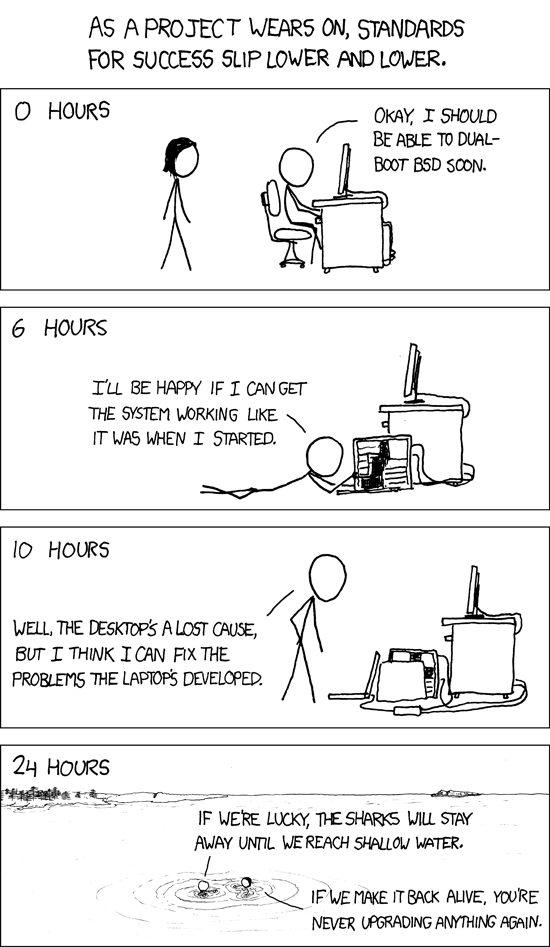
xkcd, and grommit
MarkCC tackles Erlang
This should be fun. Mark Chu-Carroll, best known as the author of Good Math, Bad Math, is “going to start writing a series of tutorial articles on Erlang”, probably the hottest language around right now. ((Ruby is so 2005, you know.)) I suspect we’re going to hear some fairly strong opinions…. Don’t miss ’em!