Really brief this time – I have to get to bed; I’m supposed to be on a 5:30am flight from BOS to PHL tomorrow morning. (Customer visit.)
I’m an “early Stones” kind of guy: I’m afraid that I lost interest after Sticky Fingers. The great thing about this live-in-the-studio album Stripped is that they get back to their roots without a trace of sentimentality. They absolutely rip into Street Fighting Man and never let up. Great blues, kick-ass rock. Even Angie sounds good – much better than the original version. Essential stuff – and the multimedia content is nicely done too.
Category: Music
CD of the Week: Bob Dylan's "Live 1966"
 1966. How old was I – 15, 16? Just starting 6th Form at the Royal Grammar School, High Wycombe. (I was in 6T1, taking maths, physics, and economics – a combination that drove my teachers crazy.) I was listening to more classical music than pop, folk, or rock. I was most aware of the Beatles, the Stones, the Kinks, Eric Burdon and the Animals, and Manfred Mann. However there were a number of American artists getting my attention – the Byrds, who had hit with Mr. Tambourine Man the year before, and then the Beach Boys, the Mamas and Papas, and the Supremes. (The last three mostly because my best friend John Hughes never stopped playing them, and I spent a lot of time at his house hanging out with his sister, Gwyneth… but I digress.)
And then there was Bob Dylan. From my perspective, he made an almost magical transformation: one minute he was a conventional socially-conscious folk singer, hanging out with Joan Baez and the Greenwich Village folk crowd; the next, he’d become a surrealistic poet. I didn’t have any connection to the beat scene; I didn’t listen to jazz, but enigmatic poetry was cool. Burroughs. Ferlinghetti. Ginsberg. Brautigan. Even Gerard Manley Hopkins (ignoring the religious metaphors – how pretentious). With no Google to help, I carefully transcribed the lyrics to Desolation Row and Ballad of a Thin Man, and marvelled at them. Was there some deep meaning there, or were the immediate impressions the beginning and end of it? At 15, such questions can seem profound… and perhaps they still are. No matter.
For Dylan’s early fans, his “plugging in” was a really big deal. Not so to me: Dylan, along with Simon and Garfunkel, Laura Nyro, and Leonard Cohen, was primarily a poet, and in my teenage head “poetry” and “pop music” were quite distinct categories. It took a couple of years for that to break down. The Beatles didn’t do it – they were sui generis – but albums like the Jefferson Airplane’s “Surrealistic Pillow” started the rot, and with “Electric Ladyland” Jimmy Hendrix blew the doors down. And of course one of the songs on that album that did the damage was All Along The Watchtower – that guy Dylan again.
Bootleg albums? Of course: every self-respecting student in the late 60s and early 70s had a couple of bootlegs in their record collection. And I remember that I had the chance to buy the most frequently bootlegged Dylan recording: the legendary “Royal Albert Hall” set. But at the time my interests were elsewhere: I chased Cream, and Led Zeppelin’s “Blueberry Hill” instead.
Fast forward 35 years: I find myself reading a review of the official CD release of Dylan’s “Royal Albert Hall ’66” set. It turns out that it was actually recorded at the Free Trade Hall in Manchester (a venue with fond memories, but that’s another story – maybe). And according to all the critics, it’s one of the best live rock’n’roll recordings of all time. So last week I bought it. And the critics were right. It’s the best. (I guess I forgot the pantheon: Dylan, Lennon, Hendrix, Miles. Only one left….)
I sit here, trying to remember what it was like to listen to Dylan when I was 15, and then hearing the sheer presence in this live recording. The imagery of Desolation Row is still as powerful, and enigmatic, and breathtaking as ever. And when my guard is down, Leopard-Skin Pillbox Hat sneaks up on me, and I find myself savouring the glorious absurdity of:
You know it balances on your head
Just like a mattress balances
On a bottle of wine
Your brand new leopard-skin pill-box hat
What a time.
More on Great War poetry
In my earlier piece on Some Corner of a Foreign Field I forgot to mention that one of the poems is The Volunteer by Robert Service.  I also have a powerful collection of Service’s wartime poems set to music by Country Joe McDonald, called War, War, War. It came out in 1971, was briefly reissued on CD in 1995, and is well worth getting hold of. The most gut-wrenching piece is the last: The March of the Dead (and yes, I know that this is about the Boer War, not the Great War – but the sentiment is timeless).
Speaking of Country Joe, check out the new song by the Country Joe Band, Cakewalk to Baghdad. It’s a cheerful little ditty in the spirit of the immortal I-Feel-Like-I’m-Fixin’-to-Die Rag ; and as they sing, it’s Easy to cakewalk in … not so easy to cakewalk out.
CD of the week: "Some Corner of a Foreign Field"
Because of the rehosting activity, I missed last week’s CD of the week posting. I’ll try to catch up…
This week’s CD is a little unusual, even for me. You can’t buy it in music stores, or at Amazon.com. I found it at a British goods shop in Newburyport, MA, along with the tea towels, Marmite, beer mugs, and Burbury coats. It’s produced by a small company in Worton, Oxfordshire called Classical Communications, that seems to specialize in “bespoke” CDs for musems and corporate customers. It’s run by a guy called Martin Souter, and this particular CD seems to have been a labour of love for him.
Some Corner of a Foreign Field is a collection of poems and music from the Great War of 1914-1918. It runs the emotional gamut, from fiercely patriotic to deeply cynical, from whimsical to heartbreaking. Some of the pieces are familiar – Kipling’s Recessional, Rupert Brooke’s The Soldier. Others are wholly new, at least to me – Philip Johnstone’s deeply sarcastic High Wood about postwar battlefield tourism, Edward Thomas’s As the team’s head brass, and Eleanor Farjeon’s Easter Monday. Perhaps the ones that touched me most unexpectedly were AA Milne’s throwaway piece OBE and May Cannan‘s The Armistice.
The music consists mostly of contemporary (and hence very scratchy) recordings of such songs as We don’t want to lose you (but we think you ought to go), If you were the only girl in the world (followed by the sarcastic If you were the only Bosch in the trench), A Mademoiselle from Armentiers (NOT followed by one of the ribald variations that I suspect are better known than the original), and Roses are shining in Picardy. The final sequence of poems is beautifully linked by passages from Elgar’s Nimrod and Mozart’s Adagio from Clarinet Concerto.
I’m not sure why this CD has grabbed me so strongly. In part, I suspect, it’s because of the power of the poetry: I’ve always thought that the Great War galvanized a generation of poets to produce some of the finest English poetry ever written. I wonder, too, about certain similarities between the war of 90 years ago and that of today. Of course they were tremendously different; yet both wars were marked by leadership of extraordinary stupidity and vanity, and by a reckless disregard for the waste of life.
I wonder what poetry this century’s folly will produce?

CD extra: "As Smart As We Are" by One Ring Zero
I saw a reference to As Smart As We Are on Neil Gaiman’s blog. I’m a sucker for the musically bizarre (as a teenager I was a great fan of Captain Beefheart), and the idea of a book/CD with lyrics by people as diverse as Margaret Atwood, Paul Auster, Rick Moody, and Neil Gaiman, set to klezmer music (well… sort of) was irresistible.
And it is. It’s bloody brilliant.
Further description could never do it justice. Listen for yourself. There are some MP3 samples on the website. But be aware of what a poor Amazon.com reviewer found:
Alas, while there are indeed some outstandingly clever pieces, a fair number of selections are R-rated, with vulgar and profane language and subject matter. I was looking for Monet and found Maplethorpe ! It is an unfortunate juxtaposition of 19th century instrumentals with the lyrics and subject matter of rap.
And the crowd went wild….
CD of the week: "The Best of Both Worlds" by Marillion
I’m going to be brief on this one, because it doesn’t need much explanation. I’ve been a Marillion fan since the late 1980s: I think it was my son, Chris, who introduced me to Script for a Jester’s Tear and Misplaced Childhood. Like many others, I found an echo of an earlier love in this music: it harkened back to the original Genesis* and albums such as Trespass and Nursery Cryme. (For me, Invisible Touch is the nadir, not the apotheosis of Genesis’ work. But I digress.) 
Part of the magic of the first incarnation of Marillion (from 1982 to 1988) was the slightly-manic presence of Fish, the lead vocalist. When he left, many wondered if the band would survive, and the first new release with Steve Hogarth, Season’s End seemed to confirm our fears: it was closer to pop than prog. But gradually the new band forged a new identity, and albums such as Brave and Afraid of Sunlight were eagerly snapped up. The two most recent albums, Anoraknophobia and Marbles, were self-produced by the band, financed by advanced orders from tens of thousands of fans (including me).
This album is a double CD of their work on EMI. The first CD covers the Fish era, including classics like Assassing, Kayleigh, and Warm Wet Circles. The second covers the Steve Hogarth (“H”) period up to 1997, including The Univited Guest, Waiting to Happen, and Afraid of Sunlight. (It also includes the execrable Hooks in You, but that’s what the SKIP button is for.)
If you want to understand Marillion past and present, this is a great collection. If you just want to plunge in and experience today’s Marillion, I’d recommend the 2002 release Anorak in the UK Live instead.
—
* The Genesis line-up with Peter Gabriel, Tony Banks, Mike Rutherford, Steve Hackett, and Phil Collins
CD of the week: Soul Calibur II Soundtrack
OK, this one is weird. 
I enjoy videogames, although I’m not very good at them. I don’t want to have to learn lots of complicated stuff in order to play. If learning is required, I’d rather apply it to something a bit more important. That’s why I gave up on Final Fantasy X; I couldn’t be bothered to learn how to play three-dimensional water-polo, with complicated rules, just for a game.
Some years ago I saw the original Soul Calibur game on the Sega Dreamcast, and I was mesmerised. It’s a 3D fighting game: oriental swords, axes and nunchuks rather than fists or guns, and characters ranging from hulking monsters, to ninjas, to anime-style Japanese schoolgirl heroines. (And then there’s Voldo, of course.) Gorgeous graphics, good A.I., playable at various levels from mindless “button-mashing” to intricate 10-click combination moves. I bought a Dreamcast just to play Soul Calibur. Eventually my Dreamcast died, Sega got out of the console business, and I put it all behind me.
Recently Sega released Soul Calibur II on all the major consoles, and I bought a PlayStation 2 just to play it. (OK, I do play a few other games, but 90% of the time it’s SC2.) Visually, it’s gorgeous. Playability is perhaps a little inferior to the original, but there are some nice new modes to explore.
But one of the aspects that really grabbed me was the music. (Yes, this really is a CD of the week entry!) It borrows familar themes from the original Soul Calibur, but there’s a lot of wonderful new music. Eventually I bought a Japanese import of the soundtrack on eBay.
So what kind of music is it? It’s a glorious pastiche: an amalgam of all kinds of musical styles, from John Williams-style triumphal marches to dark atmospheric passages that might have escaped from the Twilight Zone, to pastoral tone-poems. At times it’s a bit reminiscent of Sibelius’ Karelia Suite. And it draws upon musical styles (or, more often, cliches) from all around the world – flamenco from Spain (oddly the theme for a French swordsman), swirling music from an Ottoman bazaar, and characteristic pieces from China, Korea, and Japan. And the major themes are presented in many different arrangements, from full orchestra to delicate piano-violin duets.
It must be odd doing the music for a videogame. It has to stand up to incessant repetition (so the CD contains lots of relatively short passages that can be assembled in various ways), and it has to reinforce the gameplay, so consistency is important. Hardly anyone will actually listen to it, of course. And the rest of the project is so expensive that the budget for the music is pretty good; no need to skimp. Combine with a Japanese attention to detail (and, it must be said, a complete lack of musical inhibition or conventional ideas of taste), and the result is extraordinary.
And why did I choose this for my CD of the week? I have a CD changer in my car, which uses a 6-CD cartridge. I realized yesterday that the Soul Calibur II double CD has been in the cartridge for the last four months. Other CDs have come and gone, but SC2 became my own soundtrack. Odd, that.
CD of the week: Schubert: The Last Four Quartets
 Although this is a double CD containing four of Schubert’s quartets, I tend to listen to an iTunes/iPod playlist that picks out just one of them: String Quartet No. 15 in G major, D. 887 (Op. posth. 161). I first heard this piece on an old Deutsche Grammophon LP back in the late 60s or early 70s*, and I remember being stunned that a string quartet could have such symphonic proportions. At the time, I owned a nice LP box set called The Rise of the Symphony which explored the evolution of the modern symphony through works by J. C. Bach, Mozart, Haydn, and Beethoven. My immediate reaction on hearing Schubert’s G major quartet was that he’d made the symphony orchestra obsolete. OK, I was impressionable – but the work continues to exert an almost hypnotic effect on me to this day. I know that Death and the Maiden gets all the attention, but to me it’s just a warm-up for the main event.
As to the performance, I’ve listened to many quartets trying to capture the combination of ethereal beauty and naked power of the work. I had great hopes for the version on CBS by Ma/Kashkashian/Phillips/Kremer, but I found it disappointing. This budget recording by the Quartetto Italiano is deeply satisfying, however. It induces the chills up and down the spine just the way Schubert intended…..
* My brother reminds me that the LP in question was an Amadeus Quartet recording that he gave me one Christmas in 1973 or thereabouts.
CD of the week: "Four Sail" by Love
 This is not a new album. And it’s not Arthur Lee’s masterpiece Forever Changes. So why is it my album of the week?
Lee had finished up Forever Changes, and the original band was falling apart (mostly due to drugs), but the contract with Elektra was unbreakable. Arthur Lee owed them one more album. So he hired three studio musicians, power rockers who were clearly hooked on Blue Cheer, Spirit, and Moby Grape, and they recorded “Four Sail”. (For some reason, Amazon.com calls it Foursail. Whatever.) I bought it the day it came out back in 1969. I still have the vinyl, but a year ago it was finally re-released on CD, so now everyone can enjoy it.
What makes the album work so well is the interplay – and the tension – between Arthur Lee’s songs – wistful, sardonic, pensive lyrics over jazzy, Latin-influenced melodies – and the power rock trio behind him. Michael Fremer’s review on Musicangle gets into the details better than I can, but the result is a glorious album of rock’n’roll. It can stand up to any of the great rock albums from the late 60s by folks like Steve Miller, Spirit, even the Stones. Sadly, it’s been largely ignored because it isn’t Forever Changes – but it doesn’t pretend to be.
Four Sail is one of those albums that I find myself slipping into the CD changer in my car every few months… and then no matter what else is in there, Four Sail is what I listen to. It’s a “roll down the windows, crank it up and cruise” kind of album. And that’s what I’ve been doing this week….
Annual musical rituals
Although I have a large and diverse collection of music, there are only three acts that I ALWAYS go to see when they’re playing in my neighbourhood. They are Al Stewart, Porcupine Tree and the Legendary Pink Dots from Nijmegen in Holland. On Tuesday night the Dots were playing at the Middle East in Cambridge, and I went along as I do almost every year.
The Dresden Dolls opened for them, doing a short “acoustic” set. I’d been waiting for a long time to hear Amanda Palmer sing, and I was not disappointed. In addition to several original songs, she covered the Swans, Leonard Cohen, and (her tour de force) Jacque Brel’s “Amsterdam”. Stunning. I think the Dolls are in Lollapalooza this summer, so check ’em out.
The Dots are an institution for me. I first came across them in 1991 when I picked up a copy of their newly-released CD The Maria Dimension in a record store in North Wales. 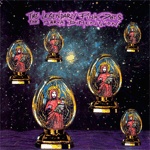 Even though I’d never heard of the Dots before, I just knew that this was something special. So I bought it, unheard, and I’ve never looked back. These days I must have 50 CDs by the Dots and another 20 solo albums by their leader, Edward Ka-Spel. They are incredibly prolific: I bought four new CDs this evening, one by Edward and three by the Dots.
The performance was excellent, as usual. Much of the material was from the newest album, Whispering Wall, but they included several oldies including (oh joy!) Casting The Runes from the 1988 album Any Day Now, and We Bring The Day from 1993’s Malachai (Shadow Weaver Part 2).
I used to find it odd being (by a considerable margin) the oldest attendee at Dots shows. These days the audience is far more diverse, in terms of age and style. Of course there are still the inevitable Goths (though why I don’t know – the Dots hardly fit the “Goth” stereotype) and fans of Ministry, KMFDM et al, complete with leather and chains. But most attendees are just plain folks of all ages from 18 to 60. And even some of the younger crowd wear ear-plugs, as I do now. Standing in front of the speakers, I feel the music more than hear it….