Small is beautiful

For some reason I find this notion of a micro compact home wholly intriguing. micro compact homeIs it really possible to create a living space in a 2.6 metre cube?

The design of the micro compact home has been informed by the classic scale and order of a Japanese tea house, combined with advanced concepts and technologies in Europe.

The tiny cube provides a double bed on an upper level and working table and dining space for four or five people on a lower level. The kitchen bar is accordingly arranged to serve these two levels. The entrance lobby has triple use and functions as a bathroom and drying space for clothing. Storage is provided off each of these four functioning spaces.

To emphasize how small it really is, here’s a picture of a unit being hauled by an SUV. There are more details at We-Make-Money-Not-Art (definitely worth a browse), and more pictures (with German text) at sueddeutsche.de. Apparently you can buy one for 50,000 Euros….

(Via BoingBoing, not surprisingly.)
Visualising chaos

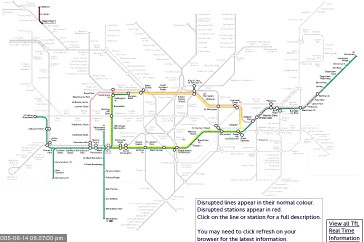
Over at whitelabel.org there’s a brilliant analysis of the state of the London Underground: tube map“In Britain, where trains are so routinely late that punctuality has been redefined as ‘within 20 minutes of scheduled time’ and even then only around 80% can make it, the people have forgotten that it doesn’t have to be this way, and that in the rest of world, including the really poor parts, it just isn’t.”

The writer grabbed the realtime disruption maps published by TfL and turned them into a three minute Quicktime movie. Tufte would be proud (I think).

While I sympathize with the author, I think he needs to get out more. The riders of the T in Boston would kill for any kind of information like that provided by TfL; disruption is a way of life over here.

(Via Boing-boing, of course.)

The Netcraft toolbar

I recently installed the Netcraft Toolbar in the copy of Firefox that I use on my home machine. Hitherto I have mostly used Netcraft for their What’s That Site Running? service (as a remote ping or to check a netblock owner). The Toolbar is new.
Every time you hit a new site, the toolbar displays five pieces of information:
– a “risk rating” (questionable)
– the date that the domain name was first noticed by Netcraft (highly unreliable)
– the rank ordering of the site by hits
– a link to a “Site Report”
– the netblock owner
I have to say that it’s changing the way I surf the web. I find myself looking at a site’s ranking, trying to understand why it’s so high (or so low). For example, my blog ranking is (at this moment) 197836. Is that good? Well, here are the top 100. Other interesting sites: Neil Gaiman’s blog is 69787, Planet Sun is 126763, and Alec Muffett’s crypticide ranks 127559. But I’m closing in on Majikthise (182579), and I’m way ahead of Simon’s Webmink (807108). Meaningful? Of course not, but it’s fun. However it only aggregates at the domain level, so all of the Sun bloggers at blogs.sun.com are going to have to share their collective ranking of 19723….

Partying like it's 1999… on the other side of the galaxy

Space 1999 Eagle modelOK, I admit it: I was a fan of the 70s sci-fi series Space 1999. And I always thought that the their spaceships, the Eagle class, really looked the part – much more so than Gerry Anderson’s earlier designs, such as Fireball XL5 and the Thunderbirds. I even preferred the Eagle to Matt Jefferies’ original Enterprise. (Heresy!)
The Eagle looked as if it had been designed by a mechanical engineer rather than an artist. No swooping curves, bold colours, or mysteriously pulsing “warp coils”: the Eagle was a grey, utilitarian, tubular framework with a series of uncompromisingly functional modular assemblies bolted on. This utilitarian style soon appeared in other 1970s sci-fi films and series, exemplified by the U.S.S. Cygnus in Disney’s disastrous Black Hole, the Millennium Falcon in Star Wars, and Battlestar Galactica. It’s probably no coincidence that this was the period when the Pompidou Centre was being constructed in Paris, with all of the plumbing, pipework, cables and service ducts on the outside of the building. Be that as it may, I thought that the Eagle looked just right, as did the Hawk variant that appeared in one episode.
Over the years fans all over the world (but especially in Japan) have kept the Space 1999 series in syndication, and I see that it’s now out on DVD at (ouch) $199. I know, I know, it’s 48 episodes on 16 discs, but even so…. Anyway, an unexpected package arrived today from the BBC America shop: a detailed, foot long, diecast Eagle. Cool! And thanks….
(Yes, the transporter pod does snap out. And I see that a Rescue Eagle version is now available. Hmmmm…)
(Update: It seems that medical and freighter Eagles are on the way too…..)