What a perfect end to a lousy week! I’ve been sick since Monday (probably a bug I picked up at the offsite in Washington DC), and not until Friday afternoon did I finally start to feel human. This morning, I woke with a feeling of pent-up energy and anticipation: I was going to see October Project. And I just did.
 You may remember October Project from the two wonderful albums that they released on Epic Records back in 1993 and 1995. The combination of magical songs by Julie Flanders and Emile Adler and the ethereal yet powerful vocals of Mary Fahl and Marina Belica wowed many fans: their live performances were pure dynamite, and the albums still keep selling. I saw them twice, once in an acoustic set and once in high-octane electric, with guitarist Julian Coryell blasting them into orbit. Inexplicably (at least to someone not in the music biz) they were dropped by Epic, and went through a turbulent time. Mary Fahl left, eventually producing a solo album that was OK, but nothing like as good as OP. Marina (decembergirl) made a nice solo EP and an intriguing instrumental album. Julie and Emile worked with several lead vocalists and backing musicians under the name November Project, and released one promising EP, A Thousand Days, which is almost like an October Project album, but…. I saw one of these line-ups at Johnny D’s in Somerville, and wondered whether or not it was going to work out. It didn’t.
At last, what many fans had hoped for came to pass: Julie, Emile and Marina got back together to re-form October Project. In the new line-up, Marina handles lead vocals with Julie singing harmony. Is it the same as Mary and Marina? No. Does it matter? Not really. The key to OP has always been the combination of the singers and the songs: the magic is holistic – forget reductionism. I can’t imagine anyone covering an OP song, and I can’t imagine OP singing anyone else’s material.
The new OP has released one excellent 6-song EP, Different Eyes, and is working on a new album, albeit without a recording contract. (I wish that they’d try the approach that Marillion used to finance their last two albums: getting fans to “pre-buy” the album over the Internet. But I digress.) Meanwhile they continue to play live with a variety of instrumentalists, mostly around their home base of New York City.
Which brings us to tonight’s concert at Capo’s in Lowell, Mass. It was the first time I’d been there, and from a look at their calendar I suspect I’ll be back. The opening act was an interesting singer/songwriter from Vermont, Gregory Douglass. The friends I was with really liked him, but he wasn’t quite my cup of tea. Never mind, I was glad of the chance to hear him.
The core trio of OP – Marina, Julie, and Emil – was augmented by three instrumentalists; I got the impression that this was the first time they’d all performed together. Martha Colby played cello. That probably gives the wrong impression; let me try again. Martha Colby played LEAD CELLO. HEAVY METAL CELLO. Think J.J.Cale’s viola on the Velvet Underground. I could imagine Martha jamming with Porcupine Tree. Don’t mess with Martha. (Plus it was her birthday.) Craig Benelly was on guitar. And a Boston-area friend of the band, Joey G., handled percussion. [If I’ve got any details wrong I hope Marina will correct me.] As usual, Emil played keyboards and added vocal harmony.
The concert was wonderful. I didn’t write down the setlist, but they did at least a dozen numbers, followed by a three-song encore. They did all of the “greatest hits”: Ariel, Falling Farther In, Take Me As I Am, Sunday Morning Yellow Sky, and Bury My Lovely. They did five of the songs from the recent EP, including See With Different Eyes and If I Turn Away. And they introduced a number of new songs. When I see a group for the first time in years, I always have a slight feeling of trepidation about new songs. “Do they still have the touch? Will they be up to the standard of the songs I’ve loved for so many years?” Well, as an Australian would say, “No worries, mate!” The new songs are OP at their finest. Two stood out in particular. The first was a moving story of a woman who finds that she was adopted, and who travels to meet her birth mother. The second was what I hope will be the title track of the new album: This Is For You. It contains some of Julie’s most compelling and poignant words, in a deceptively simple and quite beautiful setting. Marina sang it perfectly, effortlessly. It brought forth a standing ovation from the wildly enthusiastic audience.
Thanks, OP, for one of the best concerts I’ve ever been to. And thank you Marina for our conversation afterwards. I can’t wait for the album.
Morning-after update: Some particularly memorable moments:
– Emil explaining how the Sesame Street theme evolved into the music for Bury My Lovely.
– The special gleam in Julie’s eyes as she sang Always.
– Martha’s solo at the end of Sunday Morning Yellow Sky.
– Everybody singing Hey Jude to celebrate John Lennon’s 64th birthday.
– Ariel. ‘Nuff said.
Author: geoff
John Maynard Smith interview
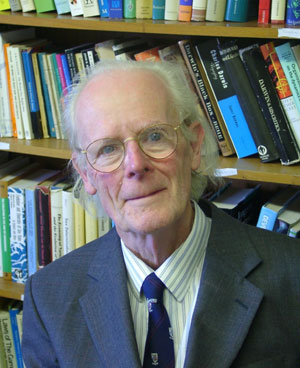 All of this stuff about Robert Wright and Daniel Dennett led me to meaningoflife.tv, a collection of interviews by Robert Wright with scientists, historians, philosophers and others. Wright doesn’t pretend to be a professional interviewer, but that doesn’t matter very much. I just watched the complete interview with the late John Maynard Smith (pictured here), probably the greatest evolutionary biologist of the 20th century. The interview runs just under an hour, and ranges from the application of game theory to evolution, to Marxism, to computers and consciousness, and death. Highly recommended. I hope the rest are as good.
Wright, Dennett, and Occam's Razor
Dan Kaplan pointed me at Wright’s response to Dennett’s complaint about his piece in Beliefnet. I don’t see that Wright gets himself off the hook. Leaving aside the validity of the argument, the ethics just stink. To reduce it to bare bones:
– Dennett said A and B
– Later on, Dennett said C
– After the interview, Wright concludes that C can be interpreted as if A then not B
– Wright therefore concludes, and announces to the world, that Dennett believes not B
Now before taking this last step, a reasonable person would have noted that this conclusion meant that Dennett had claimed B and not B. Moreover, all of Dennett’s previous statements had been consistent with B. There seem to be three possibilities:
– Dennett believes both B and not B.
– Dennett has changed his mind and now believes not B.
– Dennett still believes B; there is an error somewhere in the chain of reasoning – an equivocation, or a misunderstanding, or a subtle ambiguity.
Common sense suggests that the last of these is the most likely: in spoken (as opposed to written) discussion, such miscommunication occurs quite often. It certainly is more likely than someone changing a deeply-held belief.
So what does Wright do? Does he contact Dennett to double-check what was said and the conclusion that he’s drawn, or does he publish without checking? The first approach is most likely to lead to a true reporting of the exchange. The second has the better “Gotcha!” potential, even though it’s likely to lead to an acrimonious follow-up. (Like this.)
Maybe Wright got carried away, and thought this was a political debate in which zingers were more important than getting at the truth. That would seem to be a lousy way to practice philosophy.
UPDATE:I think I understand why Wright might have behaved in this way. If you watch the whole interview between Dennett and Wright, from about 30:00 through 45:00, you can see Dennett absolutely destroying Wright’s incoherent notion of epiphenomenalism. (I guess I should commend Wright for being honest enough to publish the interview even though he comes off so badly in it, trying to “defend indefensible positions” as he put it, but I can’t imagine that he was happy.)
More on Dennett and Wright
Yesterday I wrote of Robert Wright’s dishonest piece about Daniel Dennett in BeliefNet. After watching the video of the Wright-Dennett interview again, and re-reading Wright’s piece, I sent the following email to Wright, cc: Dennett.
I read the piece “Planet with a purpose” and then watched your interview with Dennett. I have to say that I find your triumphal announcement that:
> I have some bad news for Dennett’s many atheist devotees.
> He recently declared that life on earth shows signs of having a
> higher purpose. Worse still, he did it on videotape, during an
> interview for my website meaningoflife.tv. (You can watch the
> relevant clip here, though I recommend reading a bit further
> first so you’ll have enough background to follow the logic.)
to be wholly unjustified, based on the video interview. You attempt to couple Dennett’s agreement with your hypothetical (“to the extent that… it would support …”) with earlier elements in the discussion in order to draw the conclusion that you were seeking. I don’t find that this argument works – the earlier discussion does not support your assertion that “He has already agreed that evolution does exhibit those properties”. Furthermore you don’t even have the courtesy to ask Dennett whether or not he agrees with the conclusion that you draw. In a discussion full of analogy, hypotheticals, and probabilities, the likelihood of inadvertent or intentional equivocation is extremely high. The upshot is that your written piece smacks of “Gotcha!”, rather than reasoned argument.
Even more important, earlier in the interview Dennett spells out very clearly an alternative (“natural selections happens because it can”) which is wholly inconsistent with your “higher purpose” conclusion. Unless you believe that Dennett is supporting two inconsistent positions, this should have caused you to question whether you had drawn a valid conclusion from the discussion as a whole. Yet you completely ignored Dennett’s naturalistic position when you came to write your Beliefnet story. This seems dishonest.
For myself, I find the attempt to apply the language of evolution, or natural selection, to “the system of the planet” is unhelpful and misleading. Natural selection, as you mention in the interview, arises from a combination of differentiated replication and scarce resources. The “system of the planet” is not obviously replicating, differentiating, or competing with anything else. To treat an aggregation of planetary phenomena, living and inert, as a “system” is one thing; it certainly helps us understand things like the salinity of the oceans and the recycling of atmospheric gases. To go from “system” to “organism” is at best a metaphor of limited value, and at worst a sentimental distraction.
As you may know, at least one commentator (Andrew Sullivan) read your story and interpreted it as “An Atheist Recants”. While in most cases it is the journalist who misleads with a simplifying headline, here I believe that he accurately summarized your – wholly unjustified – conclusion.
Geoff Arnold
Dissing Dennett
I was reading Andrew Sullivan’s blog (yes, I know he’s infuriating, but he’s such an entertaining contrarian – and at least he doesn’t have Christopher Hitchens’ vicious streak), and I came across a little piece that I’ll reproduce in full:
AN ATHEIST RECANTS: Philosopher Daniel Dennett, author of the influential 1995 book, “Darwin’s Dangerous Idea,” now says he sees a higher purpose in the universe. Bob Wright breaks the news.
Now anyone seeing that headline would naturally conclude that Dennett had “recanted” his atheism – that he now believed in God. Puzzled, I read the piece by Robert Wright that Sullivan linked to. And Wright certainly launches into the topic with enthusiasm, asserting:
I have some bad news for Dennett’s many atheist devotees. He recently declared that life on earth shows signs of having a higher purpose.
So what is this “higher purpose”? We’re meant to assume that it is “God”, obviously. Yet here’s the money quote, later in the piece:
1) Dennett’s climactic concession may not sound dramatic. He just agrees reluctantly with my assertion that “to the extent that evolution on this planet” has properties “comparable” to those of an organism’s maturation—in particular “directional movement toward functionality”—then the possibility that natural selection is a product of design gets more plausible. But remember: He has already agreed that evolution does exhibit those properties. Ergo: By Dennett’s own analysis, there is at least some evidence that natural selection is a product of design. (And this from a guy who early in the interview says he’s an atheist.)
[Interjection: Note the assumption that “directionality” implies (not merely “is compatible with”) “design”, and that “design” implies a divine, non-natural designer – otherwise how is this incompatible with atheism? Sloppy. Back to Wright:]
2) Again: to say that natural selection may be a product of design isn’t to say that the designer is a god, or even a thinking being in any conventional sense. Conceivably, the designer could be some kind of natural-selection-type process (on a really cosmic scale). So Dennett might object to my using the term “higher purpose” in the first paragraph of this piece, since for many people that term implies a divine purpose. But “higher purpose” can be defined more neutrally.
So now “higher purpose” may just be an emergent property of a higher-level natural system – for example, natural selection applied to a many-worlds cosmology. I don’t see anything that Dennett has said that is incompatible with atheism.
Wright’s agenda is all too clear, as his closing paragraph shows:
Still, one could mount an argument that evolution on this planet has at least some of the hallmarks of the divine—a directionality that is in some ways moral, even (in some carefully delineated sense of the word) spiritual. In fact, I’ve mounted such an argument in the last chapter of my book Nonzero. But Dennett hasn’t signed on to that one. Yet.
And having read most of Nonzero, I’m reasonably confident that Dennett wouldn’t sign on to it. While there are some very interesting ideas in the first half of the book, the last chapter is full of equivocation, particularly around the notions of “design”, “purpose”, and “divine”. It’s nowhere near as good as Wright’s earlier The Moral Animal.
Oh goody – another test
The Dante’s Inferno Test has banished you to the Sixth Level of Hell – The City of Dis!
Here is how you matched up against all the levels:
| Level | Score |
|---|---|
| Purgatory (Repenting Believers) | Very Low |
| Level 1 – Limbo (Virtuous Non-Believers) | High |
| Level 2 (Lustful) | High |
| Level 3 (Gluttonous) | Moderate |
| Level 4 (Prodigal and Avaricious) | Very Low |
| Level 5 (Wrathful and Gloomy) | Low |
| Level 6 – The City of Dis (Heretics) | Very High |
| Level 7 (Violent) | Low |
| Level 8- the Malebolge (Fraudulent, Malicious, Panderers) | Moderate |
| Level 9 – Cocytus (Treacherous) | Moderate |
Take the Dante’s Inferno Hell Test
Indus Women Leaders conference
My colleague Nausheen is involved in Indus Women Leaders (IWL), a national forum that develops South Asian women leaders. While South Asians are one of the most successful minorities in the US, there’s a huge gap between men and women in that community, particularly in education. IWL provides South Asian women with the resources to achieve their life goals through goal setting tools, advocacy, networking, mentorship, and education. They’re holding a Leadership Summit in Boston later this month. Sun‘s sponsoring the event, and it looks really interesting.
"Dear Michael Moore…"
The Guardian has an article today in which they show some of the letters that Michael Moore has received from soldiers and contract workers in Iraq. All are bitterly angry with George W. Bush.
And yes, I’m sure Moore’s received other letters from people who support Bush. But with the election less than a month away, it’s worth paying attention to the soldier who wrote: “People’s perceptions of this war have done a complete 180 since we got here. We had someone die in a mortar attack the first week, and ever since then, things have changed completely. Soldiers are calling their families urging them to support John Kerry. If this is happening elsewhere, it looks as if the overseas military vote that Bush is used to won’t be there this time around.”
Update: The letters are taken from Moore’s new book, Will They Ever Trust Us Again?
I'm in the wrong job
Computer technology is SO 20th century! It’s time for a career change – to antimatter weapons!! Consider the example of:
…Gerald Smith, former chairman of physics and Antimatter Project leader at Pennsylvania State University. Smith now operates a small firm, Positronics Research LLC, in Santa Fe, N.M. So far, the Air Force has given Smith and his colleagues $3.7 million for positron research, Smith told The Chronicle in August.
Smith is looking to store positrons in a quasi-stable form called positronium. A positronium “atom” (as physicists dub it) consists of an electron and antielectron, orbiting each other. Normally these two particles would quickly collide and self-annihilate within a fraction of a second — but by manipulating electrical and magnetic fields in their vicinity, Smith hopes to make positronium atoms last much longer.
Smith’s storage effort is the “world’s first attempt to store large quantities of positronium atoms in a laboratory experiment,” Edwards noted in his March speech. “If successful, this approach will open the door to storing militarily significant quantities of positronium atoms.”
It seems that Positronics Research is hiring. Woo-hoo! Move over, Edward Teller. You think your H-bomb was a big bang? You ain’t seen nothin’ yet….
Note for the humour-impaired: this is sarcasm. Frame your comments accordingly.
The other George had a way with words, too…
During the tenure of the current President, many people have compared him with his father. Herewith a few bon mots from George Senior. Make of them what you will.
27 Oct 1984 “Let me assure you of one thing: the United States under this administration will never — never — let terrorism or fear of terrorism determine its foreign policy.”
28 Jan 1987 [On selling weapons to Iran] “On the surface, selling arms to a country that sponsors terrorism, of course, clearly, you’d have to argue it’s wrong, but it’s the exception sometimes that proves the rule.”
Maybe this explains why his son prefers other counsel. But sometimes they seem too much alike. More from Bush pere:
2 Aug 1988 [When the USS Vincennes shot down an Iranian airliner] “I will never apologize for the United States, ever. I don’t care what the facts are.”
4 Dec 1990 “I know what I’ve told you I’m going to say, I’m going to say. And what else I say, well, I’ll take some time to figure that all out.”
12 May 1991 “I’ve got to run now and relax. The doctor told me to relax. The doctor told me to relax. The doctor told me. He was the one. He said, ‘Relax.'”
4 Mar 1992 “Somebody asked me, what’s it take to win? I said to them, I can’t remember, what does it take to win the Superbowl? Or maybe Steinbrenner, my friend George, will tell us what it takes for the Yanks to win… one run. But I went over to the Strawberry Festival this morning, and ate a piece of shortcake over there — able to enjoy it right away, and once I completed it, it didn’t have to be approved by Congress — I just went ahead and ate it.”
More here.