Somewhere, an Apple engineering manager is committing seppuku….

I just installed the latest version of Apple’s iTunes on my PowerBook, along with an updater for the software on my iPod. Perhaps I should have read my horoscope first, or consulted the i ching. Whatever the reason, when I started iTunes it showed me an empty library, rather than the 18GB of music that I have, and it also warned me that my iPod was associated with a different library, and did I want to erase it and copy my new (empty) library? Aargh! No, cancel, quit, unplug iPod, back away from the keyboard really slowly…..

From browsing the Discussions section of Apple’s support web, it seems that a number of us have had this problem with iTunes 4.9. (See, for instance, the thread entitled “iTunes 4.9 – lost library – please help”.) The only remedy seems to be to back up the old Library files (before iTunes can mess with them), let iTunes build a new library, and then import all of the existing music. This requires that you have enough space for two copies of all your data, so I’ll have to wait until I can get home to use a FireWire drive. (I only have 7GB of free space on my 60GB PowerBook.) And you’ll also wind up losing all of your playlists, ratings, and “last played” information, which is a huge pain.

UPDATE: A Mac user called Dave Garrett just posted the following workaround:
1. Open your Music folder/iTunes folder/Previous iTunes Libraries folder
2. Re-name the file named iTunes 4 Music Library to iTunes Library
3. Drag your newly named file iTunes Library into your iTunes folder, replacing the iTunes Library that the new iTunes had created.
4. Voila.

Seems to work for me.

So long, 14th Amendment! Welcome to Scalia's two-tier USA

Over at Balkinization, Jack Balkin discusses Scalia’s uncompromising dissent in McCreary County v. ACLU, the courtroom 10 commandments case:

Scalia forthrightly explains that the Establishment Clause is not about preserving neutrality between religion and non-religion. It is not even about neutrality among religions. Rather, it requires neutrality among monotheistic religions that believe in a personal God who cares about and who intervenes in the affairs of humankind, and in particular, among Christianity (and its various sects), Judaism, and Islam.

Quite apart from its viciously divisive tone, Scalia’s argument displays remarkable ignorance. For example, he asserts that “With respect to public acknowledgment of religious belief, it is entirely clear from our Nation’s historical practices that the Establishment Clause permits this disregard of polytheists and believers in unconcerned deities just as it permits the disregard of devout atheists”. Yet the phrase “believers in unconcerned deities” clearly describes deists, a category that included many of the framers of the Constitution.

Balkin’s analysis is much more detailed than my brief note. Among other things, he dissects the curious pretzel logic that Scalia employs in including Jews and Moslems. The (scathing) bottom line: “Justice Scalia’s tradition of establishment of monotheism is, like so many other traditions, an invented tradition which he has made up to produce an outcome that he politically prefers.”

Highly recommended.

Santorum on Catholic clergy sex abuse: it's all because of liberals….

In his attempt to beat out Karl Rove for the title of Most Shameless Fabricator of Guilt by Association, Senator Rick Santorum explains the origins of child molestation by Roman Catholic priests in Catholic Online: “It is startling that those in the media and academia appear most disturbed by this aberrant behavior, since they have zealously promoted moral relativism by sanctioning ‘private’ moral matters such as alternative lifestyles. Priests, like all of us, are affected by culture. When the culture is sick, every element in it becomes infected. While it is no excuse for this scandal, it is no surprise that Boston, a seat of academic, political and cultural liberalism in America, lies at the center of the storm.”

(Via Sully. But Josh thinks Santorum first said this back in 2002.)

UPDATE: Sullivan received a great email from a reader in the Republic of Ireland which emphasizes the sheer stupidity of Santorum’s attempt to link priestly pedophilia with liberalism:

99% of schools were Catholic, 90% of the population were weekly mass goers and monthly confession was the norm for the majority. Divorce was banned by the constitution. There was no “plague of cultural liberalism”; there was no liberalism at all! It was almost a perfect Catholic State. Yet the physical and sexual abuse of children by Catholic clergy was rampant. Indeed it has been the exposure of these crimes that has revolutionized Irish society in the course of 10 years.

Visualising chaos

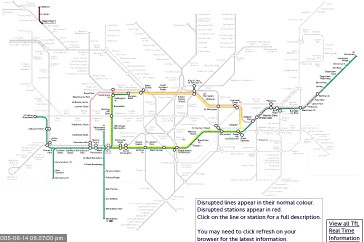
Over at whitelabel.org there’s a brilliant analysis of the state of the London Underground: tube map“In Britain, where trains are so routinely late that punctuality has been redefined as ‘within 20 minutes of scheduled time’ and even then only around 80% can make it, the people have forgotten that it doesn’t have to be this way, and that in the rest of world, including the really poor parts, it just isn’t.”

The writer grabbed the realtime disruption maps published by TfL and turned them into a three minute Quicktime movie. Tufte would be proud (I think).

While I sympathize with the author, I think he needs to get out more. The riders of the T in Boston would kill for any kind of information like that provided by TfL; disruption is a way of life over here.

(Via Boing-boing, of course.)

On the guilty pleasure of reading a really bad book

This is going to be long – skip it if you’re in a hurry.

Today I was at Sun’s Santa Clara campus for an all day meeting of the DEs. We finished up on time, just after 5pm. The last session had left me feeling exhausted: a 20 minute presentation stretched to a relentless 40 minutes, followed by a complicated debate. I felt like a drink and some food (my body is still pretending that it’s on East Coast time), but 5:30 seemed a bit early to eat. I therefore decided to drive over to the nearby Micro Center store and do what geeks do: ogle hardware and software. There’s a passable Mexican restaurant in the same plaza (the Mexicali Grill), and I thought I might find a book or magazine to read over dinner.

The store was very quiet, and the few customers seemed to be lowering their voices as if they were in a library. I found nothing of interest in the Mac section, or the PDA accessories, or the magazines, or even the discount DVDs. (I wonder who buys those boxed collections of 20 horror movies from the 1950s, not to mention The Neverending Story Volume 2.) And so I made my way to the book section.

It just so happens that I’ve been discussing the possibility of doing some work with Sun’s Network Storage Division, the group that sells such products as the StorEdge 9990 array and the QFS file system software. I’m quite familiar with our products, and I used to work on distributed file system software such as PC-NFS, but there are parts of the storage business that I know little about. So when I came across a large book about storage systems, I started browsing it. The table of contents looked promising. I checked the price: $5.99, reduced from around $50. I put this down to overstocking, bought a copy, and went off to have dinner and a bit of a read.

By the time I’d finished my salad, and a Silver Bullet margarita, I realized that I had acquired a Really Bad Book. It was weird: the organization was plausible, and by speed-reading I could sustain the illusion that it more or less flowed and made sense. But if I slowed down and looked carefully at individual sentences, they were gibberish: ungrammatical, rambling, cliché-ridden, and full of non-sequiturs. At first it was annoying, but by the time I reached the end of the first chapter it had become simply hilarious. Some examples, with original punctuation:

“The corollary, or trade-off to this condition, is the economics of speed and capacity to price.”

“Within the SAN, these operations become more logical and have to coexist with other servers that share the fabric network and devices connected.”

“Finally, as the sophistication of the centralized mainframe computers was downsized, the capability to house larger and larger databases demanded the deployment of the database server.”

It goes on and on like that. Verb agreement is a matter of happenstance; dereferencing a pronoun should only be attempted by trained professionals. At times we seem to enter an Alice in Wonderland world of topsy turvy relationships:

“The most critical element of performance for a business application is its availability to its own data.”

And sometimes a sentence seems to have been assembled by a surrealist playing with magnetic fridge poetry pieces; here’s a final, glorious example.

“Unless the hardware and firmware release levels are inventoried and tracked in conjunction with the network, the NAS systems become unassociated storage servers unbound to the confines of the network in which they operate.”

I cannot shake off the image of a row of NFS servers growing large, colourful wings and fluttering away like butterflies towards the setting sun – unbound, free of the confines of the network!! Excelsior!!!

[I’ve done my best not to identify this book or its author. If you figure it out, please keep quiet. There’s no point in stirring the pot.]
Evolving evolution

In discussing Pigliucci’s review of Jablonka and Lamb’s controversial book Evolution in Four Dimensions, Jason Rosenhouse (a.k.a. Evolutionblog) makes a key point that it’s easy to overlook:

…the problem facing evolutionary biologists is never ‘How could bit of anatomy X possibly have evolved naturally?’ Rather, the question is ‘Of the many possible mechanisms by which this system might have evolved, which is the correct one?’ It seems that scientists are constantly discovering new mechanisms for explaining evolution….

Of course, any talk of fiddling with the neo-Darwinian synthesis tends to make the hearts of creationists go pitter pat. They know that any suggestion that the nineteen fifties version of evolution may have been incomplete can be spun into a statement that evolution is dying. They will conveniently ignore the fact that the discoveries that are persuading scientists of the incompleteness of the original synthesis are all in the direction of making evolutionary change easier, not harder, to explain.

[Emphasis added.]

Dramatic changes

Photo_062205_030.jpgThis morning I had breakfast at a Hobee’s in Mountain View. When I came out of the restaurant, I noticed that there was a Supercuts next door, and that it had just opened. On a whim, I went in for a haircut. Maybe it was the breakfast burrito I’d just eaten; perhaps it was a side effect of the Flexeril I’ve been taking for a pinched nerve in my leg. Whatever the reason, I threw caution to the winds. Not only is the ponytail gone; I’m pretty sure that this is the shortest my hair has been in at least 20 years….

[UPDATED: In response to requests, I’ve added a crude phonecam pic. The beard’s a bit fluffy around the edges; I won’t be able to trim it properly until I get home.]